Ask what was averaged
An average can summarize only locations where the listing appeared, or it can incorporate successful locations where it was absent using a declared score cap. These answer different questions. A visible average describes performance conditional on being found. It does not describe coverage across the whole sample. Read the report's formula and successful-point count before interpreting an attractive average as strong neighborhood visibility.
Source checks: Google Maps live advanced SERP results · Tips to improve your local ranking on Google
Use the owned sample as a teaching dataset
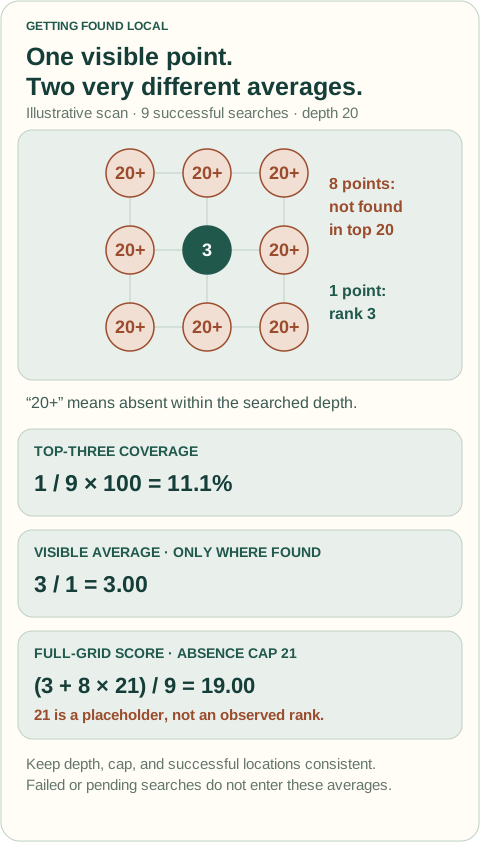
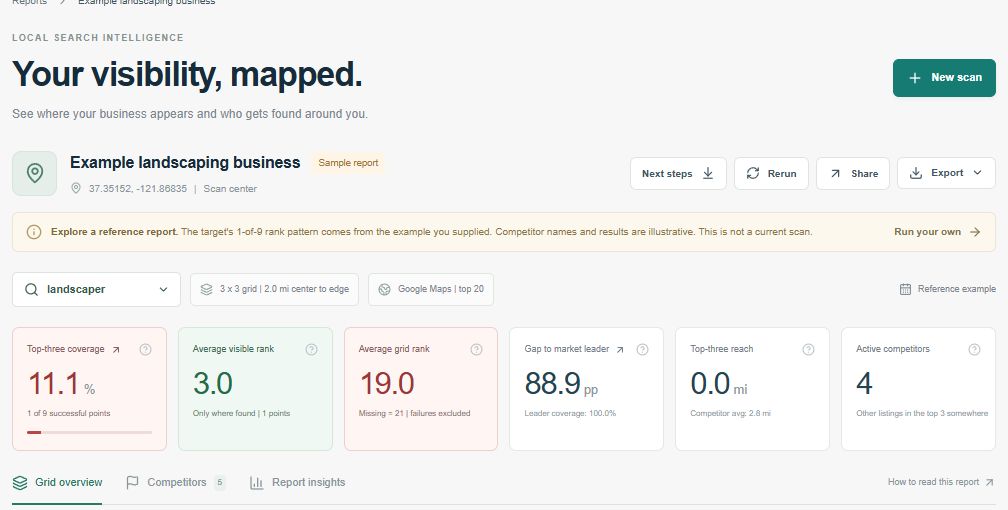
The owned Visibility demonstration uses nine successful sample points and a target rank pattern found at one point, at rank three. Other competitor listings and their ordering are explicitly illustrative; the demonstration is not a current live business scan or measured client result. Its purpose is to show how one observed good rank can coexist with broad absence within the chosen depth. Real decisions need an actual comparable scan and verified listing identity.
Calculate the visible mean and coverage
For the sample target, visible average rank is three because there is one found observation with rank three. Top-three coverage is one successful top-three point divided by nine successful included points, or approximately 11.1%. State the found count beside the visible average. If the target is never found in successful results, the visible mean is unavailable rather than zero or an invented rank.
Define a cap before using a full-grid mean
One transparent custom scoring method assigns depth plus one to successful points where the target was not returned. With depth 20, that cap is 21. Average the found rank and capped successful absences, excluding failed or pending searches. The resulting number is a capped score, not proof that the business literally ranked 21 at every absent point. Another tool may use a different convention, so comparable scoring requires matching definitions.
Avoid comparing unlike scores across scans
Changing depth, cap, exclusions, or the set of successful locations can change the full-grid mean without a corresponding ranking change. Preserve those settings and report the found share alongside the score. Organic Maps group rank also differs from an absolute position that includes other result types. The source's result definition and the app's scoring definition both belong in the comparison, especially when a report imports data from another provider.
Choose a coverage task rather than celebrating the average
Inspect the successful absent locations and keyword intent, then review accurate business information and relevant service destinations for a practical improvement task. Compare later scans with the same configuration and track inquiries separately. A good rank at the center may be useful but does not promise reach in neighboring areas. The report should help the owner understand the conditional average, actual sampled coverage, and scoring convention before making an SEO claim.
Worked example: illustrative figures
Owned illustrative sample: the target appears at rank 3 in one of nine successful points. Visible mean is 3.00 and top-three coverage is 1 ÷ 9 = 11.1%. With depth 20 and a declared missing-result cap of 21, the custom full-grid mean is (3 + 8 × 21) ÷ 9 = 19.00. The eight 21s are scoring placeholders for successful absence, not observed ranks. This sample is a teaching demonstration with illustrative competitor data, not evidence of current live rankings or a customer outcome.
Your practical checklist
- Read the exact definition of the displayed average.
- Show the number of successful found points.
- Compare visible mean with coverage.
- Declare depth and any missing-result cap.
- Keep failed and pending searches out of observed scoring.
- Label the owned sample and illustrative competitors honestly.
Your next action
Take one grid report and display found count, visible average, top-three coverage, and the declared scoring cap on the same review note.
Questions about this task
Does average visible rank 3 mean I rank third everywhere?
No. It averages only the successful locations where the listing was found. The sample's found count and coverage show whether that observation extends across the grid.
Is a capped score of 21 an actual Google rank?
No. It is a declared reporting placeholder when the listing was absent within depth 20. Keep that scoring convention distinct from an observed result position.
Sources and editorial notes
Prepared with AI-assisted research. Official sources are linked below; worked examples and checklists are Getting Found Local recommendations, not measured client outcomes.
Sources checked October 13, 2026. Platform interfaces and local resources may change; follow the current instructions on the linked official page.
How we research, illustrate, and update these guides · Suggest a correction