Identify what each map point actually means
An included point requests a search at a specified location. Its state may be successful, failed, or pending; some points may be intentionally excluded before submission. Those states must not be collapsed into one red 'not ranking' pin. DataForSEO's Maps documentation defines coordinate searches and result fields, while this guide's coverage formula is an original reporting definition. Google explains that local results depend partly on search location, so the sample's geographic scope matters.
Source checks: Google Maps live advanced SERP results · Tips to improve your local ranking on Google
Separate valid absence from unavailable evidence
A successful search returning no matching target listing means the listing was not observed within that search's configured result depth. That is different from a timeout, rejected task, or still-pending request. Missing evidence cannot establish absence. Keep status and error information with each point, and preserve stable listing identity. Do not insert a rank penalty for a failed search and then describe it as an observed poor ranking.
Separate coverage, usable data, and request progress
Top-three coverage equals successful included points with target rank one through three divided by all successful included points. Valid-data availability equals successful included searches divided by included requested searches. Finished-request progress counts both successful and failed terminal requests, divided by included requested searches; pending requests are not finished. A completed failure supplies no ranking observation. State the denominators beside the metrics.
Deliberately excluded points are outside the requested sample and should be listed as such, not counted as failed searches. If no successful included point exists, coverage is unavailable; zero percent would incorrectly suggest a measured sample with no top-three visibility.
Inspect where missing evidence is concentrated
An 80% valid-data availability rate can still leave a meaningful geographic gap if failures cluster along one edge or in an important neighborhood. Show the unavailable points on the map and review whether the remaining sample answers the business question. Avoid asserting coverage of an entire area because most requests finished. A retry or new run needs the app's supported task handling and cost safeguards; ambiguous paid submissions should not be automatically resubmitted.
Compare only a fair common sample
When two dates have different unavailable points, headline coverage may change because the denominator changed. Compare the same successful locations where appropriate and label the restricted comparison, or complete a fresh comparable scan. Preserve the whole-run valid-data availability and request-progress figures alongside it. A small difference with uneven missing evidence deserves review before it is described as an SEO improvement. The grid remains a sampled observation rather than a count of customers or search demand.
Turn the limitation into a practical next task
Check the listing, keyword intent, map region, and completed point details before selecting an improvement. Address confirmed profile or page relevance issues using legitimate business information, while keeping ranking hypotheses separate from facts. Monitor the next comparable run and actual inquiries together. The report should explain where the business was observed, where it was not observed within depth, and where no reliable search evidence was available.
Worked example: illustrative figures
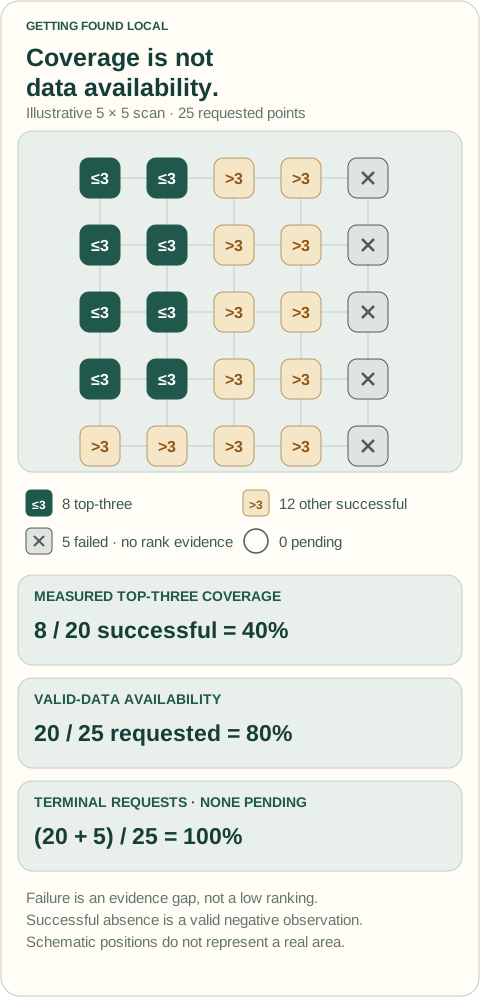
For example, a scan requests 25 included searches. Twenty finish successfully and five finish with errors. The target is top three at eight successful points, so measured top-three coverage is 8 ÷ 20 = 40%. Valid-data availability is 20 ÷ 25 = 80%. All 25 requests reached a terminal state, so finished-request progress is 25 ÷ 25 = 100%; that progress figure does not mean every point supplies usable ranking evidence.
Treating the five failures as observed absence would produce 8 ÷ 25 = 32%, but that would answer a different, misleading question. The report shows 40% measured coverage with five unavailable locations. It cannot establish the target’s ranking at those locations or convert the percentage into market share. If five requests were pending instead, usable data would still be 80%, but finished-request progress would also be 80%.
Your practical checklist
- Keep success, failure, pending, and exclusion states distinct.
- Match the target by listing identity.
- Use successful included searches for coverage.
- Show usable-data availability separately from finished-request progress.
- Inspect geographic clustering of unavailable points.
- Use comparable locations when reviewing dates.
Your next action
Read one report’s status counts and write its coverage, valid-data availability, and finished-request progress with each denominator stated.
Questions about this task
Is a failed point the same as ranking below the scan depth?
No. A failed search supplies no reliable ranking observation. A successful result where the target is absent supplies a depth-limited observation.
What should coverage show when every search fails?
Unavailable, alongside zero successful searches. Zero percent would imply an observed sample that found no top-three positions.
Sources and editorial notes
Prepared with AI-assisted research. Official sources are linked below; worked examples and checklists are Getting Found Local recommendations, not measured client outcomes.
Sources checked October 13, 2026. Platform interfaces and local resources may change; follow the current instructions on the linked official page.
How we research, illustrate, and update these guides · Suggest a correction